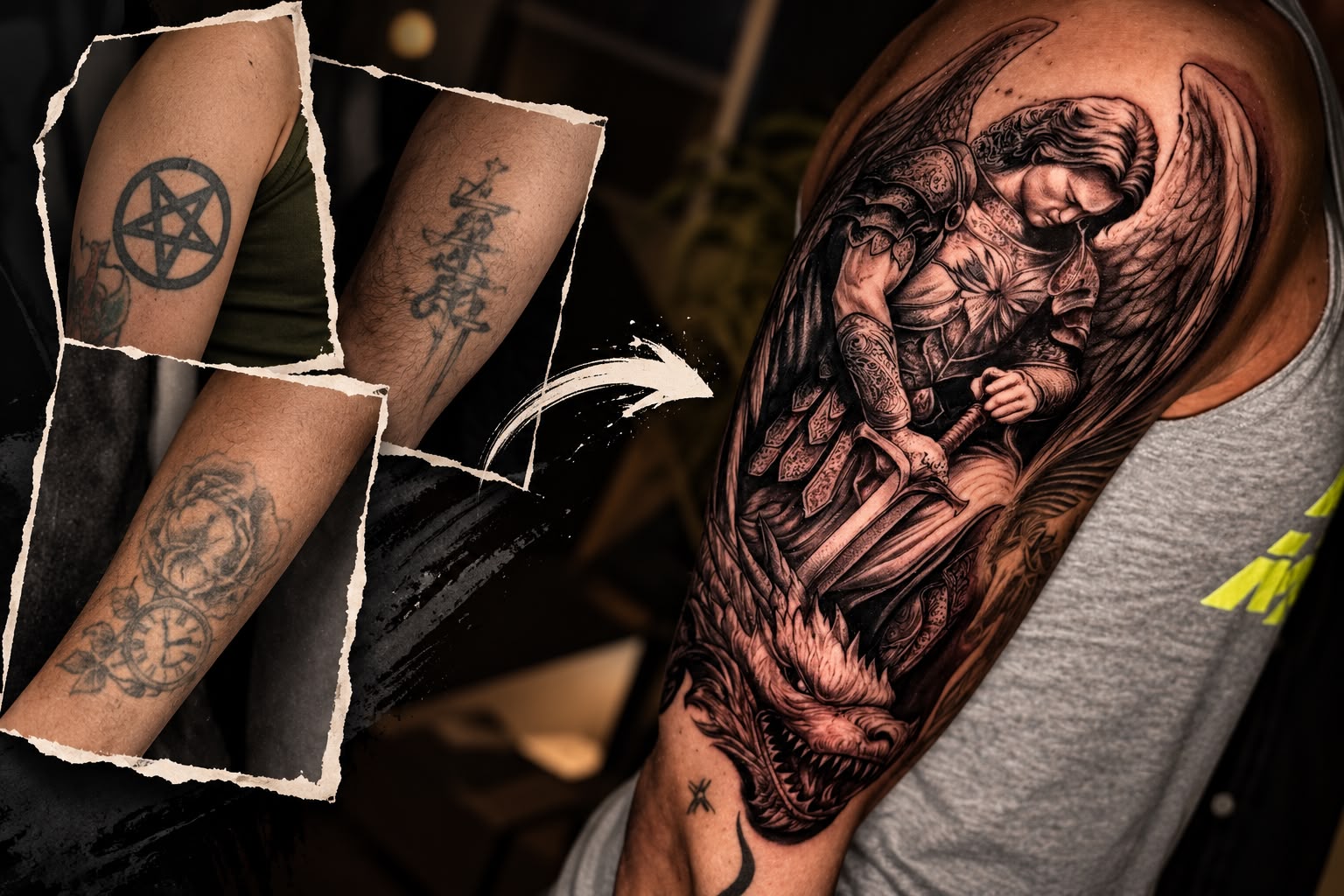
Not every tattoo stays meaningful forever.
Maybe you got a tattoo years ago and your style has changed. Maybe the design has faded, the lines have blurred, or the tattoo simply doesn’t feel like “you” anymore. And sometimes, it’s not even about regret , you may just want something fresh.
That’s where a tattoo cover-up can be a great option.
Instead of removing your old tattoo completely, a skilled tattoo artist can work with the existing ink and transform it into a completely new design. With the right concept, your old tattoo can become the foundation for something bigger, more detailed, and more personal.
Here are some tattoo cover-up ideas and things to consider before getting started.
What Is a Tattoo Cover-Up?
A tattoo cover-up is a new tattoo designed specifically to hide or incorporate an existing tattoo.
The artist uses darker areas, patterns, shading, textures, and carefully planned shapes to make the old tattoo less visible or completely concealed.
The key difference is that a cover-up isn’t simply placing another random tattoo over the old one.
The new design needs to be planned around the size, color, placement, darkness, and shape of your existing tattoo.
That’s why choosing an experienced tattoo artist is especially important for a cover-up.
1. Turn It Into a Larger Tattoo
One of the most common cover-up approaches is going bigger.
If your existing tattoo is small, expanding the artwork gives the artist more room to hide the original design naturally.
For example, a small symbol could become part of:
- A large floral tattoo
- A realistic animal
- A Japanese-style tattoo
- A mandala
- A black-and-grey composition
- A nature-inspired sleeve
Going larger doesn’t necessarily mean the old tattoo has to disappear under a solid block of ink. A good artist can use the existing lines as part of the new composition.
2. Floral Tattoo Cover-Ups
Flowers are incredibly versatile when it comes to tattoo cover-ups.
Roses, lotuses, peonies, chrysanthemums, and other detailed flowers can work well because their petals and darker areas give artists plenty of opportunities to disguise old ink.
You can also add leaves, stems, shadows, and background elements to create more depth.
Why floral designs work well:
- They can cover irregular shapes.
- Dark shading can hide older ink.
- They can be customized to fit different body parts.
- They work in both color and black-and-grey styles.
A flower that looks beautiful on its own can also have a deeper meaning, making the cover-up feel like a fresh start rather than simply hiding an old tattoo.
3. Japanese Tattoo Cover-Ups
If you’re looking for something bold, Japanese tattoo designs can be an excellent direction.
Traditional Japanese-inspired artwork often uses strong outlines, dramatic shading, and larger compositions. Designs such as koi fish, dragons, tigers, waves, masks, and peonies can provide enough detail and coverage for challenging tattoos.
For example, an old tattoo on the forearm might be transformed into a larger Japanese composition featuring a koi fish surrounded by waves and flowers.
The existing tattoo becomes part of the planning rather than something you constantly have to work around.
4. Black-and-Grey Realism
Realistic tattoos can also be adapted for cover-ups, especially when the artist understands how to work with contrast.
Animals, portraits, skulls, clocks, landscapes, and other realistic designs can use different levels of shading to disguise the old tattoo.
However, realism requires careful planning.
The artist needs to understand where the old tattoo is darkest and position the darker elements of the new design accordingly.
A useful rule: the darker parts of the old tattoo usually need to be covered by equally dark or darker elements in the new design.
5. Mandala and Geometric Designs
Mandalas and geometric tattoos can be another creative option.
Their symmetrical patterns allow an artist to build a larger design around an existing tattoo. Dark sections can be strategically placed over areas where the old ink is most visible.
These designs can work particularly well on areas such as:
- Forearms
- Upper arms
- Shoulders
- Thighs
- Calves
- Chest
If you like clean, structured artwork, a mandala cover-up can completely change the appearance of an older tattoo.
6. Turn the Old Tattoo Into Part of the New Design
Here’s an idea many people don’t consider: you don’t always have to completely hide the old tattoo.
Sometimes, the existing tattoo can become part of the new artwork.
A faded symbol could become a small element inside a larger illustration. Old lines might be incorporated into a pattern, background, or abstract design.
This approach can make the tattoo feel more intentional.
Instead of thinking, “I need to hide this tattoo,” you can approach it as, “How can we transform this into something better?”
7. Consider a Blackwork Cover-Up
If your existing tattoo is very dark, a blackwork design may be one of the more practical options.
Blackwork uses bold black areas, patterns, linework, and negative space to create strong visual contrast.
It can be especially useful for tattoos that have already become heavily faded or blurred.
Popular ideas include:
- Blackwork animals
- Abstract patterns
- Dark florals
- Ornamental designs
- Geometric artwork
- Blackwork sleeves
The final result can look completely different from the original tattoo.
Things to Consider Before Getting a Cover-Up
A cover-up is a creative process, but there are a few things you should think about before booking your appointment.
1. The Existing Tattoo
Your artist will look at the tattoo’s:
- Size
- Color
- Darkness
- Line thickness
- Fading
- Placement
All of these factors influence what designs are possible.
2. The New Tattoo May Need to Be Bigger
Don’t choose a design simply because you like how it looks on Pinterest or Instagram.
Your artist may recommend making the new tattoo larger so they have enough space to properly cover the old one.
3. Darker Designs Often Work Better
Very light or minimal designs may not be suitable for covering a dark tattoo.
Your artist may recommend stronger contrast, deeper shading, or darker elements to achieve a clean result.
4. Multiple Sessions May Be Recommended
In some cases, an extremely dark or saturated tattoo may benefit from laser tattoo removal or lightening before the cover-up.
This can give the artist more options when designing the new tattoo.
You don’t necessarily need complete removal. Sometimes lightening the existing tattoo is enough.
5. Choose the Artist Carefully
This is probably the most important point.
A regular tattoo and a cover-up require different types of planning. Look for an artist who has experience with cover-ups and check their previous work.
Ask to see:
- Before-and-after cover-ups
- Large tattoo projects
- Similar placements
- Similar styles
- Healed tattoo results, if available
A portfolio can tell you a lot about an artist’s ability to work with existing ink.
Can Any Tattoo Be Covered Up?
Not every tattoo can be covered in exactly the way you imagine.
Very dark, heavily saturated, or large tattoos can limit your design options. The placement can also make a difference.
But that doesn’t mean you’re out of options.
An experienced artist can assess your tattoo and explain what is realistically possible. In some cases, they may recommend a larger design, a darker style, or some laser lightening before starting the cover-up.
Final Thoughts
An old tattoo doesn’t have to stay something you dislike.
With the right design and an experienced artist, it can become the starting point for something completely new, whether that’s a detailed floral piece, Japanese artwork, realistic tattoo, mandala, or bold blackwork design.
The best cover-up is one that doesn’t just hide the past but gives you a tattoo you’re genuinely excited to wear.
Thinking about covering an old tattoo? Book a consultation with an experienced cover-up artist, discuss your ideas, and let them create a design that works with your existing ink.
Leave a Reply